09 January 2025
From Soil to Solution: Restoring Our Earth Through Phytoremediation

Ng Chuck Chuan

From East Asia to Australia and back, my international attachments to the three top-notch universities: Seoul National University (South Korea), National Taiwan University (Taiwan ROC) and the University of Melbourne (Australia).

included with a series of meetings, discussions, laboratory visits and lectures, altogether paving the path for research collaboration opportunities with renowned experts even as I gleaned fresh technical insights to enhance my research in soil heavy metals remediation, particularly through phytoremediation.


Met Laureate Professor and Director of Global Centre for Environmental Remediation (GCER) at the University of Newcastle (UoN), Prof. Dr. Ravi Naidu, who is also the Managing Director of the Cooperative Research Centre for Contamination, Assessment and Remediation of the Environment (CRC CARE), an independent organisation focusing on research, technology development and policy guidance for assessing, cleaning up and preventing contamination of soil, water and air.


Health, Science and Technology
Dato' Professor Dr. Adeeba Kamarulzaman
Recipient for Year 2022
Something that is worth doing is often tough, but the rewards can be big.
While phytoremediation is a promising soil remediation technique, its effectiveness depends on the type of contaminant, soil composition, and plant species used to improve soil health. As not all plants are suitable for phytoremediation, comprehensive testing is needed to identify the optimum species for specific contaminants and soil conditions.

The discovery and rise of emerging contaminants such as per- and poly-fluoroalkyl substances (PFAS) from non-stick cookware, water-repellent fabrics, stain-resistant coatings and food packaging; polybrominated diphenyl ethers (PBDEs) from electronics, furniture, building materials, textiles and automobiles; as well as endocrine-disrupting chemicals (EDCs) from plastics, pesticides, personal care products, industrial chemicals and pharmaceuticals in soil - all pose additional challenges due to their widespread industrial and consumer discharge. These contaminants are persistent and difficult to degrade, requiring specialized remediation approaches, particularly in complex environments like urban areas or industrial sites. These highlight the need for complementary techniques and new approaches to achieve more effective soil restoration.

Despite its potential, phytoremediation needs to be integrated with other strategies, such as soil amendments and microbial treatments, including mixed treatments like combined biological, chemical, and/or physical remediation techniques to enhance the efficiency and effectiveness of soil restoration. For instance, incorporating biochar into the soil could enhance phytoremediation as it improves soil structure and promotes microbial activity, thereby increasing contaminants such as heavy metal uptake by plants. This reveals opportunities to enhance remediation by addressing the slowness and limitations of phytoremediation, achieving more efficient soil restoration with a multi-faceted approach.

Through these attachments, I will refine my research methodologies with innovative techniques and new insights. The experience has helped me lay the groundwork for future projects on comprehensive soil remediation strategies, towards advancing environmental sustainability and soil health, for the benefit of generations to come.

Here’s a review of my learning expedition…
Seoul National University (SNU), South Korea (19 February - 8 March & 5 - 17 May 2024)

Hosted by Assoc. Prof. Dr. Xin Zhao from the Department of Civil and Environmental Engineering, my time at SNU was filled with tours of research facilities and laboratories which unpacked practical insights into phytoremediation techniques for soil remediation.

These initial meetings with Dr. Zhao laid the groundwork for identifying potential areas for collaborative research in environmental bioremediation.

Building upon the insights gained during my overall international attachments, particularly from my visits to SNU, National Taiwan University (NTU), the University of Melbourne (UniMelb), and other esteemed institutions, my discussions with Dr. Zhao focused on synthesizing the knowledge acquired and integrating it into our ongoing research endeavours on phytoremediation.

National Taiwan University (NTU), Taiwan ROC (8 - 21 March 2024)

Here, Distinguished Prof. Dr. Zeng-Yei Hseu from the Department of Agricultural Chemistry graciously hosted my visit.

I gained practical insights into advanced phytoremediation techniques and had the opportunity to mentor some of Prof. Hseu’s postgraduate students. The exchange of knowledge and ideas during this period was instrumental in broadening my understanding of soil remediation.


Group meeting and presentation with the NTU Soil Survey and Remediation Laboratory post-graduate students.


With Assoc. Prof. Dr. Ya-Fen Lin and Distinguished Prof. Dr. Zeng-Yi Hseu (NTU Professor for Soil Remediation) at the NTU Soil Museum.
Universities across the Greater Tokyo, Japan (21 March - 4 April 2024)
In Greater Tokyo, Japan I met with Prof. Dr. Yohey Hashimoto and his research team at the Tokyo University of Agriculture and Technology (TUAT). These meetings allowed for the exchange of ideas and insights on soil remediation techniques.

Additionally, I had the privilege of meeting with Prof. Dr. Kohei Watanabe from Teikyo University, Dr. Jian Pu from the United Nations University - Institute for the Advanced Study of Sustainability (UNU-IAS), and Prof. Dr. Kentaro Miyawaki from Meisei University. I also engaged with Prof. Dr. Keiko Yamaji and her research team members at the University of Tsukuba, further enriching my understanding of environmental sustainability and potential collaboration avenues for bioremediation studies.


Touring around the University of Tsukuba main campus.


With Prof. Dr. Yohey Hashimoto at the Tokyo University of Agriculture and Technology (TUAT)
Universities in New South Wales, Australia (4 - 20 April 2024)
Here, I engaged with Assoc. Prof. Dr. Megan Murray, Phyto-Lab research leader at the University of Technology Sydney (UTS), and Prof. Dr. Balwant Singh at the University of Sydney (UoS).

I also had the privilege of meeting with Laureate Prof. Dr. Ravi Naidu, the Director of the Global Centre for Environmental Remediation (GCER) at the University of Newcastle (UoN). Prof. Naidu's expertise in environmental remediation and his role as the Managing Director of the Cooperative Research Centre for Contamination Assessment and Remediation of the Environment (CRC-CARE) offered valuable insights into contamination assessment and remediation strategies.

Prof. Dr. Megharaj Mallavarapu, Dr. Yanju Liu and Dr. Ying Cheng from GCER at UoN also added to discussions focusing on heavy metals phytoremediation issues which further enriched my understanding and approach to soil remediation.


Visited Assoc. Prof. Dr. Megan Murray, PhytoLab Research Leader at the University Technology Sydney (UTS).
Engaged and discussed phytoremediation issues with Prof. Dr. Megharaj Mallavarapu from the Global Centre for Environmental Remediation (GCER) at the University of Newcastle (UoN).
Having dinner together with Dr. Yanju Liu and Dr. Ying Cheng, Research Scientists from the Global Centre for Environmental Remediation (GCER) in Newcastle city center.
University of Melbourne (UniMelb), Australia (20 April - 5 May 2024)
I worked with Assoc. Prof. Dr. Suzie Reichman, Director of the Centre for Anthropogenic Pollution Impact and Management (CAPIM), and her team at the Ecotoxicology Laboratory. My time at UniMelb was marked by a series of presentations and interactive sessions with postgraduate students, enhancing my understanding of heavy metal bioremediation techniques.

I also met Dr. Alex Duan (Melbourne TrACEES Platform), Mr. David De Souza (Metabolomics Australia, Bio21 Molecular Science and Biotechnology Institute), and Dr. Augustine Doronila to whom I owe a gratitude for providing practical insights into the application of phytoremediation techniques in real-world contexts.

At La Trobe University, I met Prof. Caixian Tang's research group, and toured the AgriBio facilities which enhanced my appreciation for interdisciplinary soil pollution remediation. I seized the opportunity to dialogue with two researchers, Assoc. Prof. Dr. Jorge Paz-Ferreiro and Dr. Dane Lamb, at RMIT University, toured their research facilities which provided new perspectives on addressing soil pollution challenges through innovative phytoremediation strategies.


Group photo together with my main host professor in Australia, Assoc. Prof. Dr. Suzie Reichman, also the Director of Centre for Anthropogenic Pollution Impact and Management (CAPIM) at the University of Melbourne (UniMelb).
Visited Metabolomics Australia, Bio21 Molecular Science and Biotechnology Institute (Bio21 Institute), at the UniMelb and toured around the top-end facilities with Mr. David De Souza, Bio21 Facility Manager.

Visited Dr. Alex Duan at the Melbourne TrACEES Platform (Trace Analysis for Chemical, Earth and Environmental Sciences) within the UniMelb, that serves as a one-stop solution platform to support existing and initiate new research requiring high quality surface chemical analysis, trace elemental and speciation analysis, and associated structural chemical analysis.

Together with Dr. Augustine Doronila at the UniMelb System Gardens.


My experience as a Merdeka Award Grant for International Attachment recipient has been truly transformative. It provided me with invaluable research insights into soil remediation, particularly the potential application of phytoremediation.

Collaborating with renowned experts across Asia and Australia, I refined my research methodologies and gained exposure to innovative techniques. These experiences have not only enriched my ongoing research but have also laid the groundwork for future projects focused on developing comprehensive soil remediation strategies.

Through these international attachments, I gained a broader perspective on the challenges and solutions in soil remediation, which is crucial for tailoring effective strategies. My commitment to advancing environmental sustainability and soil health has deepened, fuelled by the collaborative experiences and insights I gained. Looking ahead, I remain dedicated to fostering international partnerships and embracing diverse perspectives to tackle the complex issues of soil pollution in Malaysia. Together, we can create a healthier and more sustainable environment for the generations to come.


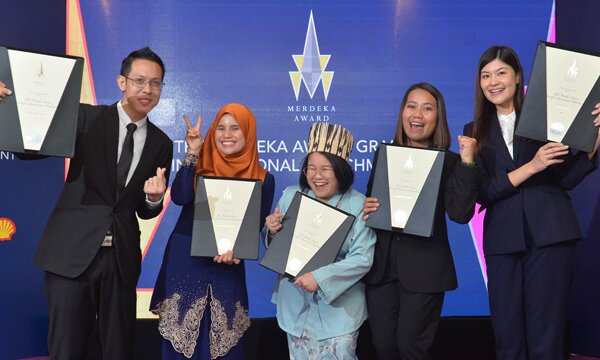
Award certification during the 2023 Merdeka Award Grant For International Attachment ceremony.

Group picture together with His Royal Highness Sultan Nazrin Muizzuddin Shah as the Royal Patron and Chairman for the Merdeka Award Board of Trustee during the 2023 Merdeka Award Grant For International Attachment ceremony.

Latest from The Merdeka Award
The 2023 Merdeka Award Grant for International Attachment has been awarded.
We can now study sound in living organisms, from the molecular to the ecological.
If you missed the session, stay tuned for the full video coming up soon! Lots of hot stuff in store!
Malaysians Under 35 Invited to Secure 3-Month Attachment Experience Abroad
Ooops!
Generic Popup2