Fostering a Culture of Excellence



A quick look at Dr Ong’s LinkedIn profile will inevitably turn into a long scroll. The list of awards, publications, research papers, and more are jaw-dropping to say the least. He holds multiple editorial positions in several industry-renowned publications and is cited on Clarivate Analytics’ Global Highly Cited Researchers 2019 and 2020 index.
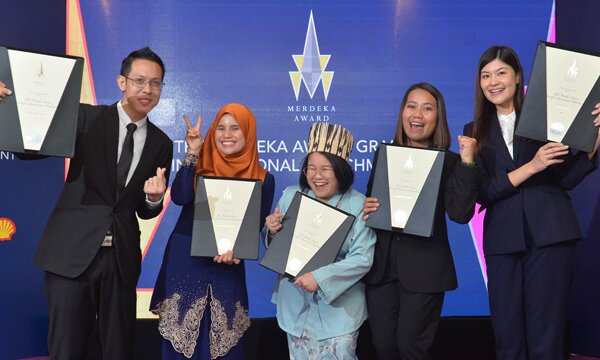
Dr Ong was also the recipient of the prestigious Merdeka Award Grant for International Attachment (MAGIA) in 2018 for his research project “Solar Energy Conversion and Energy Storage to Address the Seriousness of Energy Security and Environmental Issues by Mimicking the Ingenuity of Nature”. In layman’s terms, Dr Ong’s research could change the face of natural fuel sources.
He is a familiar name in the ‘green industry’ having won the Green Talent Award from the German Ministry of Education and Research in 2018. He was one of 25 young scientists chosen for the award in recognition for his research project that converted carbon dioxide and solar energy into clean fuel.
“In my project, I am developing nanostructured materials, which mimics the natural leaf. Plants in natural photosynthesis convert water and CO2 with the aid of sunlight into chemical fuels. My nano materials aim to do that – take sunlight and naturally transform it into an energy dense chemical fuel.”
Dr Ong’s particular line of research advances green energy, in line with the World Economic Forum’s Top Ten Emerging Technologies in 2020 [1].
“It is a way toward clean and renewable fuel production via solar-to-chemical energy conversion. This aligns with the United Nations’ Sustainable Development Goals and also the Shared Prosperity Vision (SPV) 2030 announced by the Malaysian government as a blueprint toward a more sustainable future for our society.”
“The whole world is exploring nanotechnology, but I believe that there must be a process from fundamental research to industrialization. I hope that from this process, the efficiency can be increased for industrialization. For example, the use of nanotechnology to turn water into hydrogen via solar-light-driven catalysis by scientists Fujishima and Honda in 1972 was a momentous breakthrough in the history of mankind. This can be extended to other renewable energy processes such as the reduction of CO2 to energy fuels, and more,” he said.
Attachment-in-LBNL-USA-Nanomaterials-Synthesis-8.jpg
Representing Malaysia to the World
“When I applied for the Grant, I had just come back from my 2-year employment as a Staff Scientist with the Agency for Science, Technology and Research (A*STAR) in Singapore. My hope was to advance science and technology in Malaysia. I wanted to contribute back to society and uphold the spirit of Merdeka to represent Malaysia as well as bring fame to the host institutions.”
“The Grant was very essential to my early-career research. The connective collaborations, in having a senior mentor and advisor, helped tremendously in progressing my research journey. Even after the end of my attachment, I still maintain my collaboration with Professor Ager, in national grant applications as well as other on-going research activities.”
In fact, it was the technological experience that Dr Ong gained from his Grant attachment that resulted in the establishment of the Centre of Excellence for NaNo Energy & Catalysis Technology (CONNECT) at Xiamen University Malaysia.
On Dr Ong’s website, he talks about NanoECats and CONNECT. Rest assured it has nothing to do with ‘linking felines’ but rather highlights Dr Ong’s work, his new directorship, and his passion for nanotechnological innovation.
“The Grant advanced my research portfolios, and because of my consistent achievements and research recognition, I was appointed as the Founding Director of CONNECT from 2021. This is a wonderful and particularly important opportunity to bridge the gap among university, industry and scientific publishers.”
Kumpulan Penyelidik Muda Merdeka Award:
Faktor ‘WOW’ kepada Kejayaan