Fostering a Culture of Excellence


Astrophysicist Assoc Prof Dr Nur Adlyka Ainul Anuar isn’t just reaching for the stars; she’s literally making discoveries in distant galaxies.
The Universiti Kebangsaan Malaysia senior lecturer’s groundbreaking work on black holes has not only made her the only female astronomer in Malaysia studying these cosmic phenomena, but also the recipient of the Merdeka Award for Outstanding Contribution to Science, Technology & Innovation in 2021, at age 31.
“Black holes are regions in space where the gravity is so strong that nothing, not even light, can escape from them,” says Assoc Prof Nur Adlyka.
“These black holes play an important function in shaping the universe, influencing the formation of galaxies, stars and even affecting the flow of matter and energy in space,” adds the 35-year-old.
Despite initial reservations from her family on her studying astrophysics, citing low career prospects, she followed her passion with unwavering commitment.
Her defining moment came in 2017, during her PhD studies at Durham University (UK), when she led an international team that discovered a hidden supermassive black hole in a nearby galaxy.
This achievement didn’t just bolster her love for astrophysics; it solidified her role as a leader in a largely underappreciated field in Malaysia.
Success, however, didn’t come without challenges.
As a mother juggling family life with a demanding academic career, she had to navigate the delicate balance between personal responsibilities and professional ambition.
But with the support of her husband and a strong resolve, she has set clear boundaries, ensuring that her family remains a priority while continuing her groundbreaking research.
“Motherhood has given me a new perspective on my work. It has reinforced the importance of nurturing future generations, not just through research but also through mentorship and public engagement.”
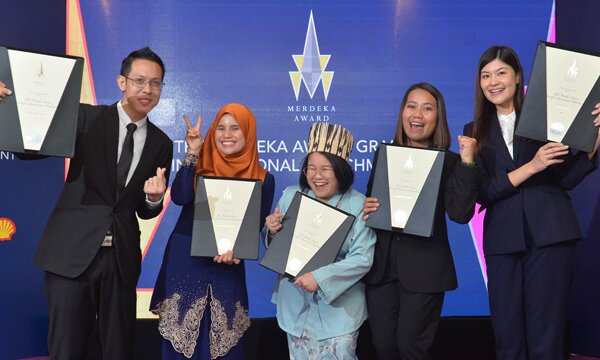
Assoc Prof Nur Adlyka’s experiences abroad, particularly through the Merdeka Award Grant for International Attachment, provided her with invaluable exposure.
Time spent at leading institutions like Durham University in Britain and Caltech in the United States not only enriched her research but also expanded her global network, leading to exciting opportunities, including contributing to a proposal for a new Nasa telescope.
Beyond her scientific achievements, Assoc Prof Nur Adlyka is a strong advocate for women in STEM.
“While women in Malaysia enjoy better representation in fields like physics and astronomy compared to Western countries, many challenges remain,” she says.
“In local universities, female students often outnumber male students in these fields. This is also the case for professional astronomers in Malaysia, where there are more females than males. However, issues such as life balance and subconscious biases hinder their career progression,” she adds.
Her solution is advocating for policies that support flexible childcare provisions as critical steps to help women thrive in scientific careers.
Assoc Prof Nur Adlyka believes pop culture references like The Big Bang Theory have made complex scientific concepts more familiar to the public.
This has helped increase public awareness and understanding of astrophysics, and sparked interest in the field.
Nurturing future innovators
Assoc Prof Nur Adlyka’s research into supermassive black holes and active galactic nuclei holds the promise of unlocking some of the universe’s deepest mysteries.
But she also believes in the significance of astrophysics beyond studying stars.
“Many everyday technologies, such as WiFi, digital cameras, artificial security, and even medical imaging, were developed based on astrophysics research.”
“By encouraging young Malaysians to engage with space science, we hope to nurture future innovators and critical thinkers who will drive Malaysia’s scientific advancement,” she says.
To Assoc Prof Nur Adlyka, mentorship plays a pivotal role in empowering the next generation of scientists.Benefiting from strong mentors during her academic journey, she now dedicates time to guiding young researchers, particularly women, offering them the support and encouragement needed to break new ground in their respective fields.
“To me, being a scientist, regardless of gender, is about curiosity, discovery, and the drive to seek answers.“Science has shaped my journey by constantly pushing me to think critically, solve problems, and understand the structure of the universe.”
Her advice for young Malaysian women in science is clear and heartfelt:“Believe in yourself. Don’t let anyone hold you back. Seek out mentors, build a strong network, and face challenges with confidence.”