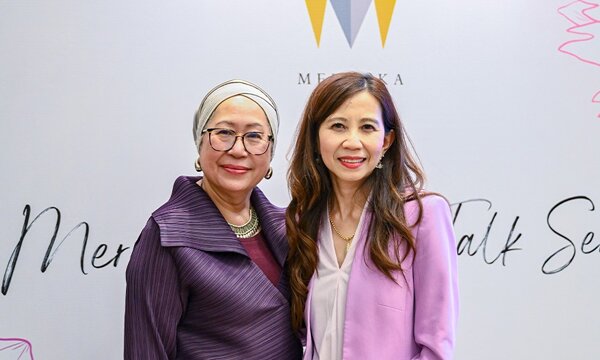
Emeritus Professor Dato' Dr Hajah Asmah Haji Omar
Recipient of Outstanding Scholastic & Academic Achievement 2026

Introducing Samuel Isaiah, 2022 Merdeka Award’s first Anugerah Harapan Merdeka recipient!
Health, Science and Technology
Dato' Professor Dr. Adeeba Kamarulzaman
Recipient for Year 2022
Something that is worth doing is often tough, but the rewards can be big.
Language as the Life of a Nation
For Emeritus Professor Dato’ Dr Hajah Asmah Haji Omar, language has never been merely a collection of words.
It is a reflection of behaviour, culture and knowledge – a living record of how people understand themselves and relate to one another.

Across more than six decades of scholarship, Professor Asmah has devoted herself to studying, documenting and strengthening Malaysia’s languages, from Malay and its dialects to the indigenous languages of Sabah, Sarawak and Orang Asli communities. Her work has helped shape language policy, education and linguistic scholarship while preserving knowledge that might otherwise have been diminished with time. More fundamentally, it has contributed to a deeper understanding of the extraordinary linguistic heritage of a nation in which the way people speak can reveal stories of place, identity, community and belonging.

For Professor Asmah, receiving the 2026 Merdeka Award for Outstanding Scholastic & Academic Achievement is a moment of gratitude to Allah SWT. She regards the honour not as hers alone, but as one shared with her parents, grandparents, teachers, mentors, family and the many people who encouraged her intellectual curiosity. Throughout her life, she has been guided by the importance of thinking deeply, asking questions and sharing what one learns.

Emeritus Professor Dato’ Dr Hajah Asmah Haji Omar.
A Childhood Shaped by Many Languages
Long before Professor Asmah became a linguist, she was already growing up among languages.

In Jitra, Kedah, Malay and Siamese were part of her daily life, while Arabic could be heard from students at her father’s Madrasah An-Najah, many of whom came from Malaya, North Sumatra and Southern Thailand. Then, at the age of eight, English entered her world.

Her education eventually took her to the Malay Girls’ College in Kuala Lumpur before she returned to Kedah to pursue her Higher School Certificate at Sultan Abdul Hamid College.

By the time university beckoned, her teachers were encouraging her to continue her studies in Britain. Instead, Professor Asmah chose Universitas Indonesia in Jakarta. Although she had read extensively about Britain, she realised she knew comparatively little about neighbouring societies closely connected to the Malay world. So, in 1958, at just 18, she left for Indonesia.

Jakarta opened up an entirely new linguistic world for Professor Asmah. Her studies in the Indonesian Language and Literature required proficiency in Arabic, Sanskrit, Old Javanese and Modern Javanese. She also learnt Dutch and French so she could access academic works unavailable in English.

That breadth of learning would later shape Professor Asmah’s distinctive approach to linguistics. Language, she came to understand, could not be studied in isolation. To understand how people speak, one must also understand where they came from, the cultures that shaped them and the histories carried within their words.
Persevering Through Resistance
After completing her Bachelor’s and Master’s degrees, Professor Asmah joined Universiti Malaya (UM) in 1963 as a lecturer in Linguistics.
Before long, she set her sights on a doctorate at the School of Oriental and African Studies (SOAS) in London. Getting there, however, proved far from straightforward. SOAS was initially unfamiliar with Indonesian qualifications, while resistance within her department threatened her ability to obtain study leave.

Rather than abandon her goal, she approached renowned linguist Professor R. H. Robins. Her published research impressed him sufficiently for her to be invited to present her work before academics in London. She was subsequently admitted as a doctoral candidate under his supervision.

Professor Asmah eventually gave up her Commonwealth Scholarship and financed her own studies rather than resign from UM. She completed her PhD in General Linguistics at the University of London in just over two years, graduating in 1969 with pioneering research centred on the Iban language of Sarawak. In doing so, she made history as the first Malay woman ever to earn a PhD, across any field of study and anywhere in the world.

The experience reinforced a lesson that would stay with her scholarship requires independence of thought, resilience and the courage to defend one’s intellectual position.
Making history as the first ever Malay woman to earn her PhD.
Giving Malaysia’s Languages Their Place
Back at UM, Professor Asmah played an important role in implementing Malaysia’s National Language Policy, helping Malay take its place as the national and official language while ensuring English remained an important language of academic and professional access.
As Academic Assistant to the Vice-Chancellor, she helped develop language programmes for lecturers, administrators and students. In 1972, she co-founded UM’s Language Centre, which later evolved into the Faculty of Languages and Linguistics, where Professor Asmah would go on to serve as Dean.

Her influence extended to the standardisation of Malay spelling and technical terminology and to regional linguistic cooperation with Indonesia and Brunei. Yet she consistently argued that cooperation did not require uniformity. Language planning, in her view, had to serve actual users.

That practical philosophy shaped her position on issues ranging from Bahasa Baku and Jawi spelling to the borrowing of Indonesian terminology into Malaysian Malay.

Receiving the Professor Emeritus Award Certificate from the Chancellor of UM, Almarhum Duli Yang Maha Mulia Sultan Azlan Muhibbuddin Shah Al-Maghfur-Lah, Sultan Perak Darul Ridzuan.
At the launch of the Asmah Haji Omar Leaning Space at the Faculty of Languages and Linguistics, UM.
Attending the 30th Majlis Bahasa Brunei Darussalam-Indonesia-Malaysia (MABBIM) in Bandar Seri Begawan, Brunei Darussalam, 4-6 Mac 1991.
Professor Asmah leading a fieldwork training session for staff from UM’s Faculty of Languages and Linguistics.
Bringing Indigenous Languages into the Record
Professor Asmah’s fieldwork began in 1963 with the Kentak Bong language in Baling.
Over the decades that follow, she documented Orang Asli languages and indigenous languages across Sabah and Sarawak – work she called “upstream research” because it required meeting communities in their own environments.

The work went beyond recording words for posterity. Her scholarship contributed to the development of grammar, spelling and teaching resources for indigenous languages. She played a role in the standardisation and teaching of Iban and contributed to discussions surrounding the teaching of Kadazandusun as a Pupil’s Own Language.

When the future of Kadazandusun teaching was questioned, Professor Asmah helped design research that went beyond theoretical arguments. The study examined classroom experiences and parental attitudes. The results provided evidence supporting the continued teaching of the language in schools.

For Professor Asmah, this mattered because linguistic diversity was never something Malaysia needed to overcome. In fact, it was part of what the country had inherited, where every language can find “a place under the Malaysian sun.”

With indigenous students, reflecting Professor Asmah’s lifelong commitment to Malaysia’s linguistic heritage.
Indigenous conference at Damai, Kuching.
Knowledge That Continues to Travel
The scale of Professor Asmah’s scholarship is beyond extraordinary.

Across more than six decades, she has written 84 academic books, 10 school texts and 155 journal articles, in addition to contributing to numerous dictionaries, encyclopaedias and edited works.

Among her influential publications are Nahu Melayu Mutakhir, Susur Galur Bahasa Melayu, Ensiklopedia Bahasa Melayu and studies of classical works such as Hikayat Merong Mahawangsa. Even now in her eighties, Professor Asmah continues to work with Dewan Bahasa dan Pustaka on studies of Malay, Bahasa Indonesia, semiotics, conversation and Arabic-derived vocabulary.

Her leadership has also extended beyond writing. She founded the Malaysian Association of Modern Languages, established the Institute of Malay Civilization at Universiti Pendidikan Sultan Idris and supervised more than 70 postgraduate students, many of whom went on to leadership positions in academia.

Her parents often reminded her not to be kedekut, or stingy, with knowledge. That simple advice has become a lifelong principle for her. 

Professor Asmah’s journey reflects the Merdeka Award Trust’s commitment to recognising scholarship that strengthens Malaysia’s intellectual and cultural foundations. Her legacy lies not only in recording how Malaysians speak, but in helping the nation understand why language matters, carrying memory, identity and knowledge from one generation to the next.

Majlis Wacana Merong Mahawangsa, featuring one of the classical Malay works Professor Asmah studied extensively.


“Language is behaviour, culture and knowledge”
Disclaimer:
The information in this award recipient's profile is accurate to the best of our knowledge as of the time the award was presented. Any subsequent changes, updates, or developments in the individual's life or achievements may not be reflected in this profile.
Latest from The Merdeka Award
The 2023 Merdeka Award Grant for International Attachment has been awarded.
We can now study sound in living organisms, from the molecular to the ecological.
If you missed the session, stay tuned for the full video coming up soon! Lots of hot stuff in store!
Malaysians Under 35 Invited to Secure 3-Month Attachment Experience Abroad
Ooops!
Generic Popup2